

Sweepstakes casinos are the workaround that lets social gaming exist in states where regulated online casino play does not. Instead of selling entries into games of chance, they sell Gold Coins — a play-for-fun currency with no redemption value — and attach Sweeps Coins as a free promotional bonus. Sweeps Coins are what can eventually be redeemed for prizes. That structure is not a loophole in the pejorative sense; it is the same promotional sweepstakes law that governs cereal-box contests and fast-food peel-off games.
This hub explains how the model actually works, which operators we rate highest, and where new players most often go wrong. Every site listed here operates under the sweepstakes statutes of the states where it is eligible — none of them holds a gaming licence, because no regulator issues one for this category. Understanding that distinction is the single most useful thing you can take away from this page.
How the Sweepstakes Model Actually Works
Two currencies run in parallel. Gold Coins are the entertainment currency: you play slots and table games with them, you can buy more of them in packages priced in USD, and they never convert into anything of value. Sweeps Coins are the promotional currency. You never buy them. They arrive attached to Gold Coin packages as a free bonus, through daily login rewards, through social media giveaways, and — critically — through a postal request that costs nothing.
No purchase necessary. Every legitimate operator in this space publishes an alternative method of entry (AMOE) in its sweepstakes rules: a handwritten postcard or letter mailed to a stated address, which returns a set number of Sweeps Coins at no cost. The AMOE is not a courtesy. It is the legal element that keeps the promotion a sweepstakes rather than a lottery. If an operator hides it, buries it, or makes it functionally impossible to use, treat that as disqualifying.
Pro tip: Read the AMOE clause before you spend a dollar. The rules specify exact formatting — hand-printed, one request per envelope, sometimes a minimum card stock. Requests that ignore the format get discarded without notice, and operators are under no obligation to tell you why. Screenshot the clause; sites revise their rules pages without changelogs.
Best Sweepstakes Casinos: Our Comparison
Our ratings come from our own testing — game library depth, redemption friction, clarity of the sweepstakes rules, customer support responsiveness, and how honestly the site describes its own coin structure. Promotional offers below are the standard welcome packages as published by each operator; they change frequently, so confirm on-site before signing up.
| Operator | Our Rating | Welcome Offer | Standout Feature |
|---|---|---|---|
| McLuck | 88 / 100 | 7,500 GC + 2.5 SC free | 2.5 free SC on signup |
| Crown Coins Casino | 88 / 100 | 100K CC + 2 SC free | 50 SC minimum redemption |
| High 5 Casino | 88 / 100 | 250 GC + 5 SC free | 50 SC minimum redemption |
| Pulsz | 88 / 100 | 5,000 GC + 2.3 SC | 2.3 SC free on signup |
| Chumba Casino | 58 / 100 | 2M GC + 2 SC free | 2 SC free on signup |
McLuck and Pulsz lead on library breadth and the clarity of their promotional terms. High 5 Casino pairs a five-SC signup bonus with a published 50 SC redemption floor, which is transparent even if the floor itself is high. Crown Coins Casino runs its own coin branding (CC rather than GC) but the two-currency logic is identical. Chumba Casino is the category’s best-known name and offers the largest headline Gold Coin figure, but our score reflects slower redemption processing and a thinner game catalogue relative to newer rivals.
Full write-ups, including our redemption timing tests:




- Daily bonus up to 0.5 SC
- 450+ games, slots only
- Skrill payouts in 24h
What Separates a Good Sweepstakes Operator
Transparent sweepstakes rules
The official rules should be linked from the footer, dated, and written in plain English. Look for the eligible-state list, the AMOE address and format, the redemption minimum, and the prize-fulfilment timeline. Operators that state these four things clearly are the ones that have had a lawyer read the page. Vague rules are a genuine risk signal, not a cosmetic one.
A workable redemption minimum
Sweeps Coins only matter if you can redeem them. Most operators set a floor — commonly around 50 SC — before a redemption request can be submitted. A lower floor is friendlier; a high floor combined with stingy free-SC drops means most players never reach it. Check the floor before the headline bonus number, because the bonus is meaningless if it sits a long way below the threshold.
Identity verification that works
Every operator verifies identity before releasing prizes — government ID, proof of address, sometimes a selfie match. This is standard practice and reflects federal anti-money-laundering expectations administered by FinCEN, plus IRS reporting duties on prize value. The differentiator is speed and clarity. Good operators tell you exactly which documents they need up front; weak ones request them piecemeal after you have already requested a redemption.
Honest self-description
An operator that calls itself a real money casino, advertises a gaming licence it does not hold, or markets Sweeps Coins as a product for sale is either careless or deliberately misleading. None of those claims can be true under the sweepstakes model. We downgrade sites for this on sight, because the same carelessness tends to show up in how they handle player funds and prize fulfilment.
Pro tip: Complete identity verification the day you register, before you have any Sweeps Coins worth redeeming. Verification queues lengthen around big promotional pushes, and a document rejected for a blurry corner can add a week. Doing it cold, with no prize pending, removes the most common source of frustration in this category.
State Eligibility Is a Moving Target
There is no federal online gaming regulator in the United States. Federal law frames the space — the Wire Act (1961), UIGEA (2006), and the repeal of PASPA in Murphy v. NCAA (2018), which handed the question to individual states — while DOJ, FinCEN and the IRS handle enforcement, financial-crime reporting and taxation respectively.
Regulated online casino play is overseen state by state: the NJ Division of Gaming Enforcement, the Pennsylvania Gaming Control Board, the Michigan Gaming Control Board, the West Virginia Lottery, the Delaware Lottery, the Connecticut DCP and the Rhode Island Lottery, among others.
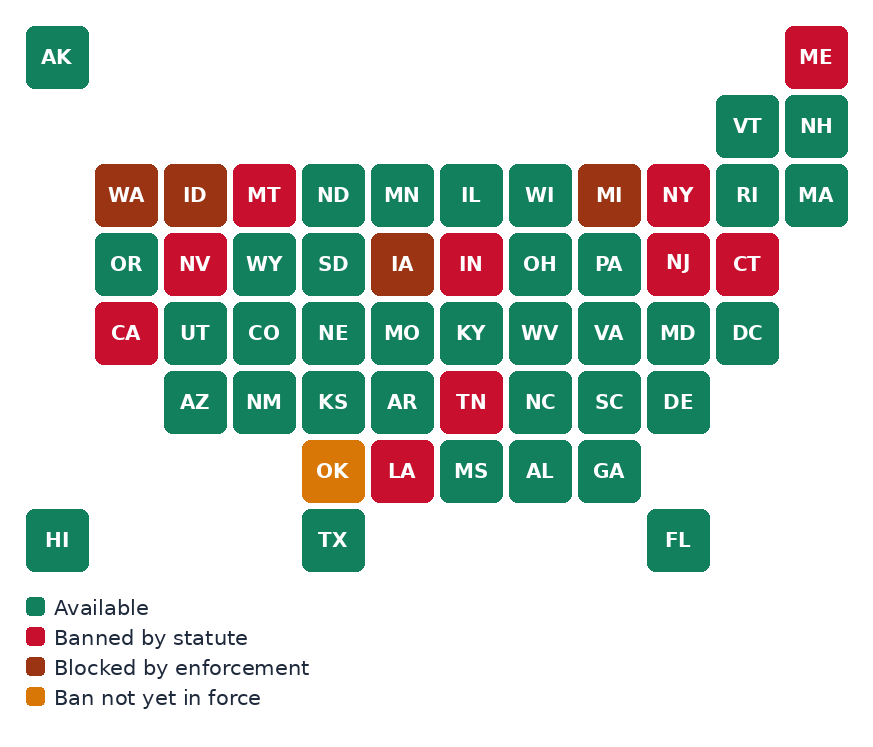
| State | Status | Law | In force |
|---|---|---|---|
| California | Banned by statute | AB 831 | 2026-01-01 |
| Connecticut | Banned by statute | SB 1235 | 2025-10 |
| Indiana | Banned by statute | HB 1052 | 2026-07-01 |
| Louisiana | Banned by statute | Dedicated statute (May 2026) | 2026-05 |
| Maine | Banned by statute | 2026 statute | 2026-06-26 |
| Montana | Banned by statute | SB 555 | 2025-10 |
| Nevada | Banned by statute | 2025/26 statute | — |
| New Jersey | Banned by statute | A 5447 | 2025-08 |
| New York | Banned by statute | S 5935A | 2025-12-05 |
| Tennessee | Banned by statute | Dedicated statute (May 2026) | 2026-05 |
| Idaho | Blocked by enforcement | State constitution and pre-existing gambling law | — |
| Iowa | Blocked by enforcement | No dedicated statute confirmed; operators have withdrawn | 2026-06-16 |
| Michigan | Blocked by enforcement | Pre-existing gambling law, enforced by the MGCB | — |
| Oklahoma | Ban not yet in force | SB 1589 (passed over the governor’s veto) | 2026-11-01 |
| Washington | Blocked by enforcement | Pre-existing gambling law, enforced by regulators | — |
Sweepstakes casinos sit outside that structure entirely. They rely on state promotional-sweepstakes statutes, which vary and are actively being revisited by legislatures. Several states have moved to restrict or ban the model outright in recent sessions, and operators respond by withdrawing from those markets — sometimes with days of notice.
Because the picture changes by legislative session, always check the current eligible-state list in the operator’s own rules rather than any static list, including ours. Age minimums are typically 18+ or 21+ depending on the operator and state; verify before registering.
Getting Sweeps Coins Without Spending a Dollar
Every legitimate sweepstakes operator is built around one principle: no purchase necessary. Sweeps Coins are never sold. You buy Gold Coin packages for entertainment play, and SC arrive as a free promotional bonus attached to that purchase — or through routes that cost nothing at all. If a site ever implies you are buying SC directly, that is a red flag about the operator, not a quirk of the model.
The alternative method of entry (AMOE) is the legal backbone of the whole structure. It has to be genuinely usable, not buried. In practice, operators offer several no-cost routes, and the mail-in request is the one required by law to exist. Reading the exact AMOE wording in the official rules takes five minutes and tells you a lot about how seriously a brand treats compliance.
| Free-entry route | How it typically works | What to watch |
|---|---|---|
| Mail-in request (AMOE) | Handwritten postcard or letter with your name, address and account details sent to the operator’s stated address | Exact formatting requirements; one request per envelope; SC credited manually, so allow days |
| Daily login bonus | A small SC amount credited for opening the app or site each day | Streak resets; the credit is often fractional SC, not whole coins |
| Social media giveaways | Promo codes posted on the operator’s own channels | Impersonator accounts; only use codes from verified profiles |
| Email and push promos | Codes sent to registered accounts, often time-limited | Short expiry windows; codes tied to one account only |
| Free SC on signup | Promotional SC credited when the account is created and verified | Some portion may be locked until identity checks clear |
Pro tip: Before mailing an AMOE request, screenshot the rules page section that specifies the address and required details. Operators update mailing addresses between promotional periods, and a request sent to a retired address is simply lost. The screenshot also gives you something concrete to reference if support disputes the format later.
Common Mistakes Players Make
Most frustration with sweepstakes sites traces back to four or five predictable errors. None of them are exotic. They come from treating these platforms like something they are not, or from skipping the paperwork step until it becomes urgent.
Mixing up the two coin types
Gold Coins have no prize value and never will. Sweeps Coins are the promotional currency eligible for prize redemption. Players who spend an evening on GC play and then discover none of it counted toward anything redeemable have simply had the wrong currency selected in the lobby. Check the toggle at the top of the screen before every session — it often defaults back to Gold Coins after an app update.
Leaving identity verification until redemption day
Verification is where the delays live. Operators need to confirm your identity and eligible-state residency before releasing prizes, and that process involves document review by a human. Starting it the moment you cross the redemption threshold guarantees the slowest possible experience. Uploading documents right after signup — clear photos, name matching your account exactly, address matching a recent utility bill — removes the single most common source of complaints.
Ignoring the redemption minimum until it matters
A minimum of 50 SC is standard across much of the market, and it shapes how long you will hold a balance before anything can be converted. Players who assume small balances can be redeemed on demand end up sitting on coins for weeks. Read the number first, then decide whether the operator fits how you actually play.
Assuming eligibility is permanent
A state that accepted registrations last year may not accept them now. Legislative sessions change the map, and operators adjust their eligible-state lists accordingly — sometimes with limited notice. Anyone maintaining a balance should check the operator’s current rules periodically rather than assuming the day-one list still holds.
Trusting third-party coin sellers
Accounts, coins and “topped-up” balances offered outside the operator’s own storefront are a straightforward way to lose both money and your account. Operators terminate accounts involved in transfers, and any SC balance attached goes with it. There is no recovery route, because there is no regulator to appeal to.
Pro tip: Register with the same name, date of birth and address that appear on your government ID, even if you normally use a shortened first name. Mismatches between account details and documents are the most frequent cause of stalled verification, and correcting a name on an existing account is far slower than getting it right at signup.
How This Differs From State-Regulated Sites
It helps to be blunt about the contrast. In New Jersey, Pennsylvania, Michigan and West Virginia, online casino play is overseen by bodies such as the NJ Division of Gaming Enforcement, the Pennsylvania Gaming Control Board, the Michigan Gaming Control Board and the West Virginia Lottery. Those operators hold state authorization and answer to a named agency with enforcement power.
Sweepstakes platforms do not. There is no regulator issuing them anything, and no federal online gaming authority exists — the Wire Act, UIGEA and the post-Murphy v. NCAA landscape frame the space, but each state legislates for itself. A sweepstakes operator functions under the sweepstakes and promotional-contest statutes of the states where it is eligible. Any brand claiming otherwise is misrepresenting itself, and that alone should end your evaluation.
The practical consequence: your recourse when something goes wrong is the operator’s own support team and, at most, a state consumer-protection office such as the Connecticut Department of Consumer Protection. That is a meaningfully thinner safety net, which is exactly why operator selection carries more weight here than it does elsewhere.
Can I buy Sweeps Coins?
No. Sweeps Coins are never for sale. You purchase Gold Coin packages, and SC are attached as a free promotional bonus. You can also obtain SC entirely free through mail-in AMOE requests, daily logins and promo codes. No purchase is ever necessary to receive SC or to redeem prizes.
Are sweepstakes casinos legal in the United States?
They operate under state sweepstakes law in the states where they are eligible, which is a different legal footing from state-authorized online casinos. Eligibility varies by state and changes with legislation, so the operator’s current rules page is the only reliable source.
How old do I need to be?
Most operators set 18+, though some require 21+ depending on the state and their own policy. The age minimum appears in the official rules and is enforced during identity verification.
How long does a prize redemption take?
Once verification is complete, processing commonly runs from under 24 hours to several business days depending on the operator and the method. First redemptions take longest because documents are reviewed then. Subsequent requests on a verified account are usually much faster.
Does playing Gold Coins improve anything?
No. Gold Coin play is purely for entertainment and produces no prize eligibility. It is useful for learning a game’s interface before committing SC, and nothing beyond that.
Can I hold accounts at several operators?
Yes, provided each account is in your own name and you meet each operator’s eligibility rules. Many players do, precisely because free-entry offers and game libraries differ. Duplicate accounts at the same operator, however, are grounds for termination.
Where to Go Next
Our individual reviews go deeper on rules wording, verification experience, redemption minimums and game selection for each brand. If you are picking a first platform, start with the redemption minimum and the free-entry offer, then compare libraries.
Pro tip: Open two or three accounts and complete verification on all of them before you need anything from any of them. Free-entry promotions rotate, and having verified accounts ready means you can act on a good offer the day it appears instead of spending that week uploading documents.
- McLuck — 7,500 GC + 2.5 SC free on signup.
- Crown Coins Casino — 100K CC + 2 SC free, 50 SC minimum redemption.
 Bonus: 100K CC + 2 SC free
- Daily bonus up to 0.5 SC
- 450+ games, slots only
- Skrill payouts in 24h
- High 5 Casino — 250 GC + 5 SC free, 50 SC minimum redemption.
- Pulsz — 5,000 GC + 2.3 SC free on signup.
- Chumba Casino — 2M GC + 2 SC free.
Whichever you choose, read the official sweepstakes rules once, in full, before your first session. It is the single highest-value fifteen minutes you can spend in this category, and it is the document that governs everything that follows.
Reading the Terms of Service Before You Sign Up
Most players skim past the terms page, and that is where the friction lives. Sweepstakes operators publish two separate documents that govern your account: the general Terms of Use and the Sweepstakes Rules (sometimes labeled “Official Rules” or “Promotional Rules”). The second one is the legally operative document for prize redemption, and it is the one worth reading.
Look for four specific clauses. The first is the definition of an eligible participant — this establishes minimum age, residency requirements, and whether employees or household members of the operator are excluded. The second is the description of the alternative method of entry, which by law must be stated with enough specificity that a person could actually follow it.
The third is the prize redemption procedure, including any verification requirements and the operator’s stated processing window. The fourth is the section on account termination, which describes the circumstances under which the operator can close your account and what happens to any Sweeps Coins balance at that point.
That last clause deserves attention. Terms typically distinguish between voluntary closure, closure for inactivity, and closure for suspected violations. In the first two cases, operators generally allow a redemption window for eligible balances. In the third, forfeiture is common. The specific triggers for a violation-based closure — multiple accounts, false information at signup, use of a VPN, chargebacks on a purchase — are usually enumerated. Knowing them in advance is more useful than discovering them during a review.
Terms also change. Operators reserve the right to amend them, and the meaningful question is what notice you receive. Some send email notification with an effective date; others simply update the page and rely on a “last modified” timestamp. If a platform you use regularly changes its redemption minimum or verification thresholds, the terms page is where it happens first.
Identity Verification: What to Expect and When
Know Your Customer checks are standard across the industry, and they are triggered by redemption rather than by signup. You can typically create an account, claim a welcome bonus, and play for some time before anyone asks for a document. The moment you request a prize redemption, verification begins.
The standard request is a government-issued photo ID — driver’s license, state ID card, or passport — plus proof of address. Proof of address usually means a utility bill, bank statement, or lease agreement dated within the last three months, showing your name and the address on your account. If you have made purchases, some platforms also request a photo of the payment card with the middle digits obscured, or a screenshot of the transaction from your banking app.
Two things cause the majority of delays. The first is a name mismatch: the account was registered as “Mike” but the ID says “Michael,” or a recent marriage changed a surname that was never updated on the account. The second is an address mismatch, usually because someone moved and never updated their profile. Both are fixable, but each round trip adds days.
Verification is generally a one-time process. Once your identity is confirmed, subsequent redemptions move through faster because the compliance step is already complete. This is the practical argument for completing verification early rather than waiting until you have a balance you want to redeem — some platforms allow you to submit documents proactively from the account settings page.
Redemption Methods and Realistic Timelines
Prize redemption on sweepstakes platforms is not instant, and the total time has two distinct components that get conflated. The first is operator processing — the internal review where the platform confirms your account is in good standing and your play history contains nothing flagged. The second is banking transit, which is entirely outside the operator’s control.
The common redemption rails are ACH bank transfer, third-party processors such as Skrill or Trustly, and in some cases gift cards or prepaid card credits. ACH transfers are the most widely offered and typically the slowest in transit, since they settle through the standard banking network. Processor-based payouts often move faster once approved because they land in a wallet rather than a bank account, though moving funds out of that wallet adds its own step.
Minimum redemption thresholds vary and are usually stated in Sweeps Coins. A platform with a low minimum lets you redeem small amounts frequently; one with a higher minimum requires you to accumulate before cashing out. Neither is inherently better, but the threshold determines how quickly you see a return on play.
Two mechanics affect what is actually redeemable. Most platforms require Sweeps Coins to be played through at least once before they become eligible — a coin that arrives in your balance and sits there cannot be redeemed directly. And promotional coins awarded through bonuses are frequently subject to their own playthrough terms, distinct from purchased or mail-in coins. Checking which portion of your balance is redeemable, rather than the total displayed, avoids a common surprise.
Tax Reporting on Sweepstakes Prizes
Prizes redeemed from sweepstakes casinos are generally treated as income by the IRS. Operators that pay out above certain thresholds issue a Form 1099-MISC, and the figure reported is typically gross redemptions rather than your net position after purchases. This is the point that catches players off guard: a year in which you redeemed a meaningful amount but spent similar amounts on coin packages can still generate a 1099 reflecting only the redemption side.
Operators collect tax information — usually a W-9 — as part of the verification process for this reason. Providing an incorrect Social Security number or refusing to supply one can trigger backup withholding or block redemption entirely.
State income tax treatment varies independently of federal treatment, and a handful of states have no income tax at all. This is not legal or tax advice, and the correct move for anyone redeeming substantial amounts is a conversation with a tax professional who can look at the full picture. What matters for planning purposes is simply knowing the 1099 may arrive, and keeping your own records of purchases and redemptions throughout the year rather than reconstructing them in April.
Responsible Play in a Free-to-Play Framework
The sweepstakes model is often described as risk-free because Gold Coins have no cash value and coins are available for free. That framing is incomplete. Coin packages cost real money, purchase prompts appear at the moment a balance runs low, and the psychological mechanics of the games themselves are identical to those in real-money environments.
Practical safeguards exist and are underused. Deposit limits, where offered, cap what you can spend across a day, week, or month and take effect immediately when tightened. Session reminders surface elapsed time. Self-exclusion removes account access for a fixed period or permanently, and reputable operators honor it without a reversal path during the exclusion window.
Warning signs worth recognizing in yourself: buying coin packages to recover a losing session, playing past the time you intended to stop, hiding purchases from a partner, or treating redemptions as expected income. If any of these apply, the National Council on Problem Gambling operates a confidential helpline at 1-800-522-4700, available 24 hours a day.