

New Sweepstakes Casinos in the US
New sweepstakes casinos launch in the US almost every month, and the newest name is not automatically the best one. This hub explains how the promotional sweepstakes model actually works, which recently launched and recently refreshed sites we rate highest, what separates a solid new operator from a thin one, and the mistakes that cost first-time players time and coins. Every brand covered here has its own full review on this site, linked throughout.
One thing to settle first: no US regulator issues a gaming licence to a sweepstakes operator, because none exists for this model. These sites operate under the sweepstakes and promotional-contest statutes of the states where they are eligible to run. That is a legal framework, not a gambling authorisation, and it is the single most misunderstood point in the whole category.
How the Sweepstakes Model Works
Every sweepstakes casino uses two separate virtual currencies. Gold Coins are the play-for-fun currency with no prize value. Sweeps Coins are the promotional currency that can be played and, once conditions are met, redeemed for prizes. You buy Gold Coin packages. You never buy Sweeps Coins — they arrive as a free bonus attached to a Gold Coin purchase, or through daily logins, social promotions, and mail-in entry.
That distinction is not marketing language. Selling the prize-eligible currency directly would turn a promotion into something else entirely under state law. Any site that tells you it sells Sweeps Coins has either written its copy carelessly or is describing something you should walk away from.
No purchase necessary. Every legitimate sweepstakes casino must offer an alternative method of entry (AMOE) — normally a hand-written postcard mailed to the operator’s stated address, returning free Sweeps Coins with no purchase of any kind. The address, the required wording, and the daily request limit sit in the official rules. A new site that buries or omits its AMOE is failing the most basic test of the model.
Pro tip: Read a new site’s official sweepstakes rules before its promotions page. The rules document tells you the AMOE address, the minimum redemption threshold, the eligible states, and the prize-redemption conditions — the four facts that actually determine whether the site is worth your time. Promotions pages tell you almost nothing useful.
Top Operators for New Sweepstakes Play
Our scores are our own, based on hands-on account testing, coin-package structure, redemption terms, game variety, and how clearly each operator documents its rules. Ratings are out of 100 and are reviewed as sites change.
| Operator | Our rating | Welcome offer | Standout feature |
|---|---|---|---|
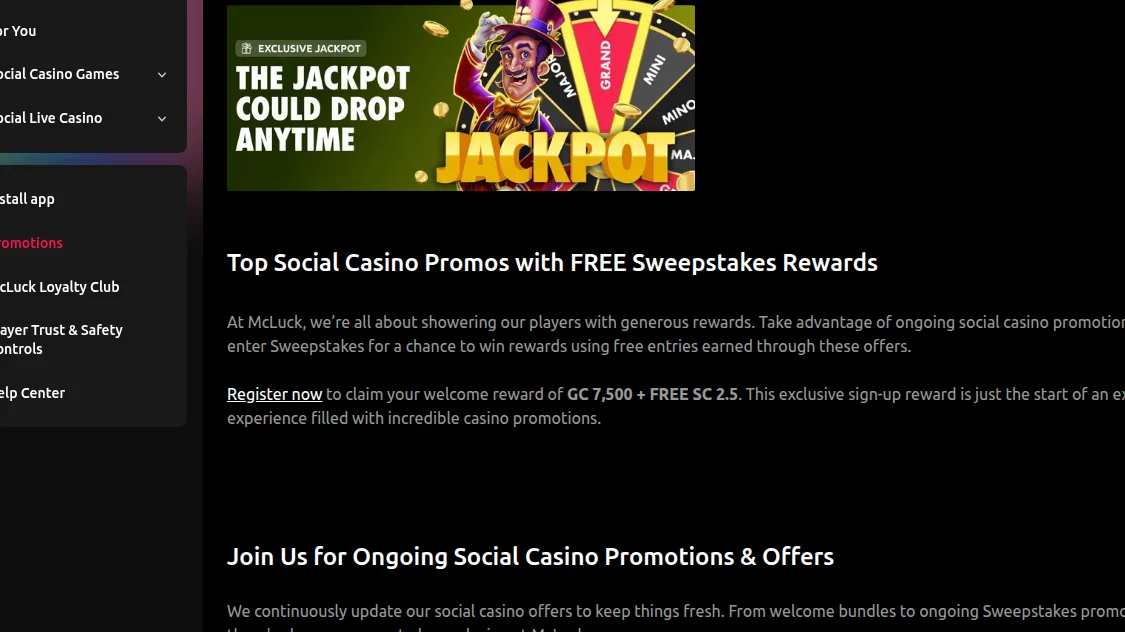
| McLuck | 88 / 100 | 7,500 GC + 2.5 SC free | 2.5 free SC on signup — one of the larger free SC starts |
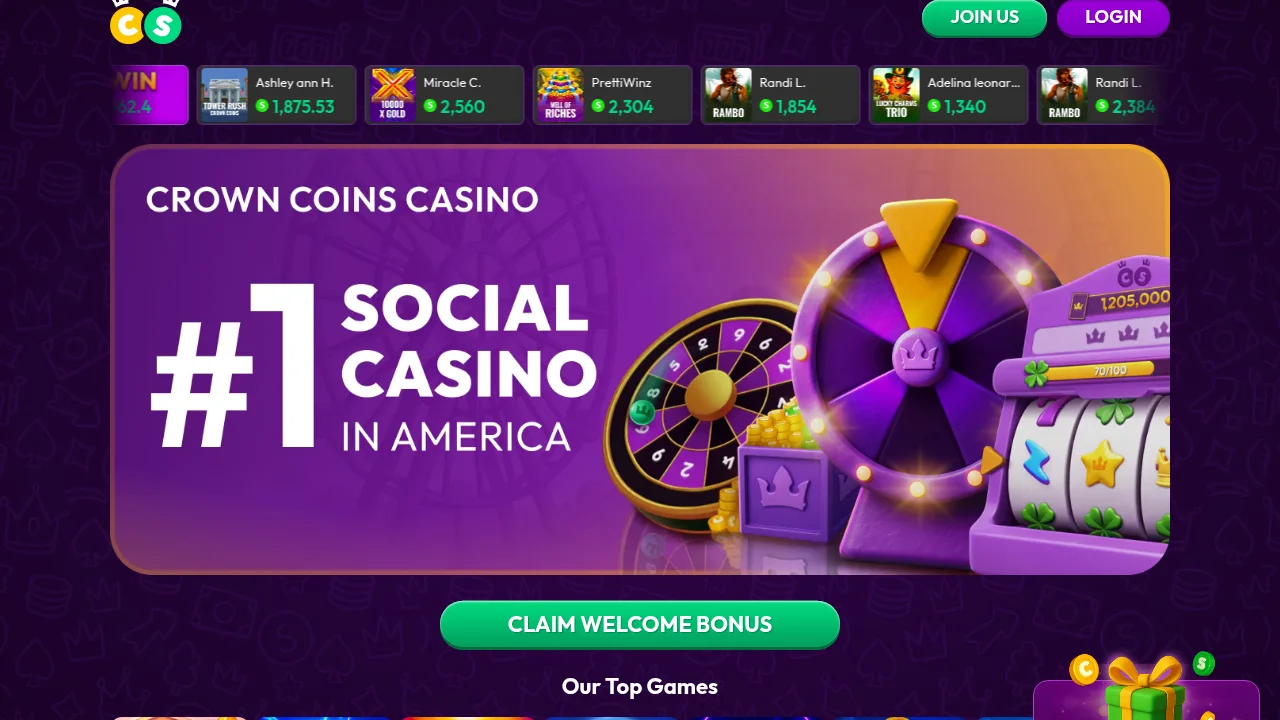
| Crown Coins Casino | 88 / 100 | 100K CC + 2 SC free | 50 SC minimum redemption |
| High 5 Casino | 88 / 100 | 250 GC + 5 SC free | 50 SC minimum redemption; deep in-house game library |
| Pulsz | 88 / 100 | 5,000 GC + 2.3 SC | 2.3 SC free on signup |
| Chumba Casino | 58 / 100 | 2M GC + 2 SC free | 2 SC free on signup; long-running brand |
The four sites tied at 88 sit there for different reasons. McLuck and Pulsz lead on the size of the free Sweeps Coin package handed to new accounts. Crown Coins and High 5 lead on the back end — a stated 50 SC minimum redemption is a concrete, checkable number rather than a vague promise. Chumba’s 58 reflects a large Gold Coin headline offer paired with terms and a platform experience that have not kept pace with newer arrivals.
Reading a Welcome Offer Correctly
Compare the free Sweeps Coin figure, not the Gold Coin figure. Chumba’s 2M GC looks enormous next to High 5’s 250 GC, but Gold Coins carry no prize value — the GC number is set by whatever denomination the operator chose and means nothing across brands. The SC figure is the only part of a welcome offer that maps to potential prize redemption. On that measure High 5’s 5 SC and McLuck’s 2.5 SC lead this table.
What Separates a Good New Operator
Clear, Findable Rules
A strong new site publishes its official rules as a plain, dated document: eligible states, age requirement, AMOE address and format, minimum redemption, and prize-redemption conditions. Weak sites scatter these across a FAQ, a footer link, and an email autoresponder. The effort a new operator puts into its rules page is a reliable proxy for the effort it puts into everything else.
A Stated Minimum Redemption
Both Crown Coins and High 5 state 50 SC as the minimum before a prize redemption can be requested. Whether you consider 50 SC high or low matters less than the fact that it is published. An operator that will not commit to a number in writing is one you cannot plan around.
Account Verification Handled Early
Every operator runs identity checks before releasing prizes — a US federal expectation under FinCEN’s anti-money-laundering framework, not an operator quirk. Good new sites let you complete verification when you open the account. Poor ones spring a document request at the moment you first request a redemption, which is exactly when the delay hurts most.
Pro tip: Upload your ID and proof of address the day you register, before you have anything pending. Verification queues at new operators are shortest in the first weeks after launch and lengthen sharply once the site scales. Doing it early removes the single most common source of redemption delays.
Payment Rails You Already Use
The US sweepstakes market runs on a familiar set of methods for Gold Coin purchases and prize redemptions: online banking and ACH (including VIP Preferred), PayPal, Play+ prepaid, debit card, Apple Pay, PayNearMe for cash at retail, and in some cases cash at a partner casino cage. A new operator supporting only one card processor is a friction point you will feel later.
State Eligibility Stated Plainly
Sweepstakes eligibility is set by state law and by each operator’s own decisions, and it changes. Washington is the standing exclusion across essentially the whole category, and several other states have seen operators withdraw following legislative or attorney-general activity. Idaho, Michigan, Nevada, and Montana have all appeared on exclusion lists at various points. Treat any eligibility list — including ours — as accurate on the date it was written, and confirm on the operator’s own rules page before registering.
Games That Are Actually Different
Many new sites license the same third-party slot catalogue, so the lobbies look interchangeable within a week of launch. High 5 is the clearest counter-example here, running a substantial in-house library alongside licensed titles. Exclusive content is one of the few genuine differentiators in a market where most new entrants launch with the same supplier list.
Redemption Timing and What It Costs
Prize redemption is where new brands separate themselves most visibly, and it is also the area where the least information is published up front. Two variables matter: how long the review of your first request takes, and whether anything is deducted along the way. Neither is standardized across the market, and a brand launching this year has no track record for you to lean on.
First redemptions are almost universally slower than subsequent ones, because identity checks run in parallel with the prize request. That is normal and not a warning sign. What is worth noting is whether the operator tells you the expected window in writing before you request, or whether you only discover it after the request is sitting in a queue.
| Operator | Our Rating | Signup Package | Stated Minimum |
|---|---|---|---|
| McLuck | 88 | 7,500 GC + 2.5 SC free | Published in terms |
| Crown Coins Casino | 88 | 100K CC + 2 SC free | 50 SC |
| High 5 Casino | 88 | 250 GC + 5 SC free | 50 SC |
| Pulsz | 88 | 5,000 GC + 2.3 SC | Published in terms |
| Chumba Casino | 58 | 2M GC + 2 SC free | Published in terms |
Crown Coins and High 5 both state 50 SC as the redemption floor, which is the clearest disclosure pattern we see in the market. A stated number lets you plan. An unstated one means you accumulate blind and find out the threshold at the moment you most want to be past it.
Pro tip: Complete identity verification on day one, before you have any Sweeps Coins worth redeeming. The documents are the same either way, and clearing them while your balance is zero removes the single most common source of delay from your first prize request.
Common Mistakes With New Sweepstakes Sites
Treating Gold Coins and Sweeps Coins as the Same Balance
This is the error that costs people the most. Gold Coins are for standard play and have no prize value. Sweeps Coins are the promotional currency that can be redeemed for prizes once conditions are met. You purchase Gold Coin packages; Sweeps Coins arrive as a free bonus attached to those packages, or through the no purchase necessary route. Playing a game in the wrong mode means the session contributes nothing toward a redemption.
Ignoring the No Purchase Necessary Route
Every legitimate sweepstakes operator must provide an alternative method of entry. In practice this is usually a mailed request card with your details, or a designated on-site request form. No purchase necessary is not marketing language — it is the structural requirement that keeps the model lawful. If you cannot find the AMOE instructions in the terms of a new brand, that absence is itself the finding.
Assuming a Brand Is Licensed Because It Looks Polished
There is no regulator issuing approvals to sweepstakes operators. A slick interface, a familiar supplier list, and a large signup package tell you nothing about oversight, because no oversight body exists for this model. These sites operate under the sweepstakes laws of the states where they are eligible. Any claim to the contrary — on the site or elsewhere — is a reason to walk away, not a reassurance.
Signing Up Before Checking State Eligibility
Eligibility is set by state law and changes as legislatures act. Washington is excluded market-wide. Several states have moved against the model in recent sessions, and others are reviewing it. Check the operator’s current eligibility list at the moment you register, not a list you read months ago. A registration from an excluded state will not survive verification, and any accumulated balance goes with it.
Chasing the Largest Signup Number
Chumba’s 2M GC headline is the largest number in the table above and the least informative. Gold Coin totals are set by whatever denomination the operator chose; they are not comparable across brands. The 2 SC attached to it is the figure that matters, and it sits in the same range as everything else. Compare the Sweeps Coin component and nothing else.
Pro tip: Read the terms section covering account closure before you register, not after. New operators occasionally reserve broad discretion to void balances for vaguely defined conduct. Specific, enumerated conditions are a better sign than a catch-all clause.
How We Assess a New Operator
Our ratings come from our own testing, not from third-party summaries. We register, complete verification, play in both coin modes, and run a redemption through to completion where the balance allows. The score reflects what we observed, weighted toward the things that are hard to reverse once you are committed: rule clarity, verification handling, and whether stated terms match actual behavior.
The four brands sharing an 88 rating did so for different reasons — Crown Coins and High 5 on disclosure, McLuck and Pulsz on the signup package and platform execution. A shared score is not a claim that they are interchangeable. Chumba’s 58 reflects a longer-standing platform whose interface and game presentation have not kept pace with what newer entrants launch with.
| What We Check | Why It Matters for a New Brand |
|---|---|
| Terms accessible pre-registration | No track record to fall back on |
| Minimum redemption stated | Determines whether a balance is reachable |
| AMOE documented | Required for the model to be lawful |
| State list current and specific | Eligibility shifts with legislation |
| Verification timing | Largest source of first-redemption delay |
| Game library composition | In-house content is a real differentiator |
Full Reviews of Each Operator
Each brand above has a dedicated review covering its coin structure, redemption terms, verification process, game library and current state eligibility. Start with the review before registering — the detail that decides whether a site suits you is rarely in the signup package.
- McLuck — 7,500 GC plus 2.5 SC free on signup.
- Crown Coins Casino — 100K CC plus 2 SC free, 50 SC minimum redemption.
 Bonus: 100K CC + 2 SC free
- Daily bonus up to 0.5 SC
- 450+ games, slots only
- Skrill payouts in 24h
- High 5 Casino — 250 GC plus 5 SC free, 50 SC minimum, substantial in-house library.
- Pulsz — 5,000 GC plus 2.3 SC free on signup.
- Chumba Casino — 2M GC plus 2 SC free, established platform.





Pro tip: Register at two or three new brands rather than one. The free Sweeps Coin allocations are small individually, and spreading across brands lets you compare verification speed and redemption handling directly before deciding where to concentrate.
Are new sweepstakes casinos legal in the US?
They operate under the sweepstakes laws of the states where they are eligible. There is no federal online gaming regulator, and no state body issues approvals for this model. Legality rests on the structure: a free entry route must always exist alongside Gold Coin purchases. Washington excludes the model, and eligibility elsewhere shifts as state legislatures act.
Can I buy Sweeps Coins directly?
No. You purchase Gold Coin packages, and Sweeps Coins are attached as a free promotional bonus. Any site presenting Sweeps Coins as a purchasable item has stepped outside the model. The distinction is not cosmetic — it is what separates a lawful promotion from something else entirely.
How do I get Sweeps Coins without spending anything?
Through the alternative method of entry. Every operator must offer one, typically a mailed request following the format set out in its terms, sometimes a request form on the site. Daily login allocations and social promotions are additional free routes, but the AMOE is the one that is mandatory.
What is the minimum age?
21 or older across the operators covered here, with age confirmed during identity verification. Some brands set 18 in specific states; the 21+ standard is the safe assumption and the one most new entrants apply market-wide.
How long does a first prize redemption take?
Longer than later ones, because verification runs alongside it. Operators that publish an expected window are giving you something to hold them to; ones that do not are asking for patience without defining how much. Clearing verification early is the single most effective thing you can do to shorten it.
Is a bigger signup package a better offer?
Only the Sweeps Coin component is comparable. Gold Coin totals reflect arbitrary denomination choices and range from 250 to 2 million across the brands above without meaning anything different. High 5’s 5 SC is the largest free Sweeps Coin allocation in this group.
What happens if my state becomes ineligible?
Operators typically close registrations first, then wind down existing accounts with a window to redeem remaining Sweeps Coins. Terms vary and the window can be short. If your state is under active legislative review, treat any accumulated balance as something to redeem sooner rather than hold.
Registration and Account Verification Steps
Signing up at a newly launched sweepstakes casino follows a consistent pattern across the US market, though the timing of each step varies. The initial registration usually asks for a legal name, email address, date of birth, and a physical address. Most sites let you play with Gold Coins immediately after confirming your email, which means you can test the software before committing any personal documents.
The heavier verification step, often called KYC (Know Your Customer), typically triggers at the point of your first redemption request rather than at signup. At that stage, an operator generally asks for a government-issued photo ID such as a driver’s license or passport, and sometimes a utility bill or bank statement that matches the address on file. Some newer platforms also request a selfie holding the ID, or use an automated identity provider that scans the document through your phone camera.
Two details cause the most friction. First, the name on your payment method must match the name on your account — a shared household bank account under a spouse’s name will usually be rejected. Second, documents must be current; expired IDs and utility bills older than roughly three months are commonly declined.
Uploading clear, uncropped images of the full document, with all four corners visible, avoids the majority of resubmission requests. Getting verified early, rather than waiting until you have a balance you want to withdraw, removes a delay that otherwise lands at the least convenient moment.
State Availability and Geographic Restrictions
Sweepstakes casinos operate under promotional sweepstakes law rather than state gambling licenses, which is why they are available across most of the country. That said, availability is not universal. Washington State is the most consistent exclusion, as its statutes treat online gaming in a way that operators have chosen not to test. Idaho, Michigan, and Nevada also appear on restriction lists at various operators, and some platforms exclude Montana, Connecticut, Delaware, or New Jersey depending on their own legal reading.
Because each operator makes its own assessment, two sites can differ on whether they accept players from the same state. A new launch may open in a narrower footprint and expand later, or may pull out of a state after a change in regulatory posture. Restriction lists are usually published in the terms and conditions rather than on the homepage, so checking that document before depositing is worth the two minutes it takes.
Age requirements also vary. The common minimum is 18, but a meaningful number of operators set 21 as the floor, and a few apply 21 only in specific states. Location is generally confirmed through your registration address and IP address rather than the GPS-based geolocation software used by real-money online casinos. Attempting to mask your location with a VPN violates the terms at essentially every operator and is grounds for account closure and forfeiture of any balance, so it is not a workaround worth considering.
Responsible Play Tools at Newer Platforms
The fact that no wager is required does not mean spending cannot get away from you. Gold Coin packages are purchased with real money, and repeated purchases add up in the same way as any other discretionary spending. Newer operators vary considerably in how well they support players who want to keep that in check.
The tools worth looking for include purchase limits that cap how much you can spend in a day, week, or month; self-exclusion options that lock the account for a fixed period or permanently; session reminders that surface how long you have been playing; and a straightforward account closure process that does not route through a retention agent trying to talk you out of it.
Established operators tend to have all of these built into account settings. Brand new sites sometimes launch with only a support-ticket process, which introduces delay at exactly the wrong moment.
Some platforms also allow you to set limits that take effect immediately when tightened but require a cooling-off period before they can be loosened. That asymmetry is a good sign — it indicates the tool was designed to actually work rather than to satisfy a checklist. If a site you are considering has no visible responsible play section at all, treat that as meaningful information about its priorities.
Customer Support Quality and Response Times
Support quality is one of the clearest differentiators between a well-resourced launch and a thin one. Live chat available around the clock is the strongest signal, followed by live chat during extended business hours, then email-only support. Response times on email can range from under an hour at attentive operators to several days at understaffed ones, and a new site handling an unexpected traffic surge often falls into the latter category during its first months.
Before you need support for something urgent, it is worth sending a low-stakes question — how long redemptions typically take, or which documents are needed for verification — and noting how long the reply takes and whether it answers what you actually asked. A canned response that restates the FAQ tells you something.
Many newer platforms also run active communities on Discord or social media where staff post about promotions and outages; these can be faster than official channels for time-sensitive questions, though they are not a substitute for a documented support process.
Mobile Apps Versus Browser Play
Most new sweepstakes casinos launch as mobile-optimized websites rather than native apps. This is a practical decision as much as a technical one, since app store policies around sweepstakes and casino-style content have historically been inconsistent, and a browser-based product avoids that dependency entirely. A well-built responsive site loads in mobile Safari or Chrome, supports portrait play, and can be saved to your home screen as a shortcut that behaves much like an app.
Where native apps do exist, they are more often available on Android than iOS, sometimes distributed directly rather than through the Play Store. Direct downloads deserve extra caution: install only from the operator’s own domain, and be aware that sideloaded apps do not receive the automatic security review that store distribution provides.
Functionally, browser play and app play rarely differ in game selection, since the underlying games are HTML5 and run in either environment. The practical differences are push notifications for promotions, slightly faster load times on repeat visits, and occasionally app-exclusive bonuses. None of these are significant enough to make app availability a deciding factor when choosing where to play.